"I'm Just Not Good at Math": Helping Your Child Change the Story They Tell Themselves
By Totally Medieval · August 29, 2026

There are few statements about education that parents should take more seriously than hearing a child say:
"I'm just not good at math."
At first, it may sound like ordinary frustration. But when children repeat that statement often enough, it can become something much bigger than frustration over fractions, multiplication, or algebra. It can become part of how they see themselves.
"I'm struggling with this" slowly becomes "I'm not good at this."
Then it can become:
"I can't do this."
And eventually:
"Why should I even try?"
For homeschooling parents and educators, one of our most important responsibilities isn't simply helping students arrive at the correct answer. It is helping them understand that struggling with a mathematical concept today does not determine what they will be capable of tomorrow.
I learned that lesson personally—not when math was easy for me, but when it suddenly wasn't.
When the Kid Who Is "Good at Math" Suddenly Isn't
Growing up, I was always pretty good at math.
Then I reached the higher levels.
Eventually I found myself sitting at home struggling with calculus. The problems weren't coming easily anymore. What had once been an academic strength was becoming a source of enormous frustration.
There was something else happening in my life at the same time.
My father had served in the military and was gone a lot while I was growing up. He had recently retired, so for one of the first times in my life, he was actually home while I was wrestling with my schoolwork.
One evening, he saw me struggling with calculus and asked if he could help.
Instead of accepting his help, I exploded.
I was a young kid with a hot temper, frustrated with calculus and carrying emotions that had very little to do with the math problem sitting in front of me.
I yelled at him:
"You're never home, and now you want to help."
He didn't yell back.
He simply walked upstairs.
And I remained there with my math.
Looking back, there is an important lesson in that moment for parents. Sometimes the emotional reaction happening over a math book isn't entirely about mathematics.
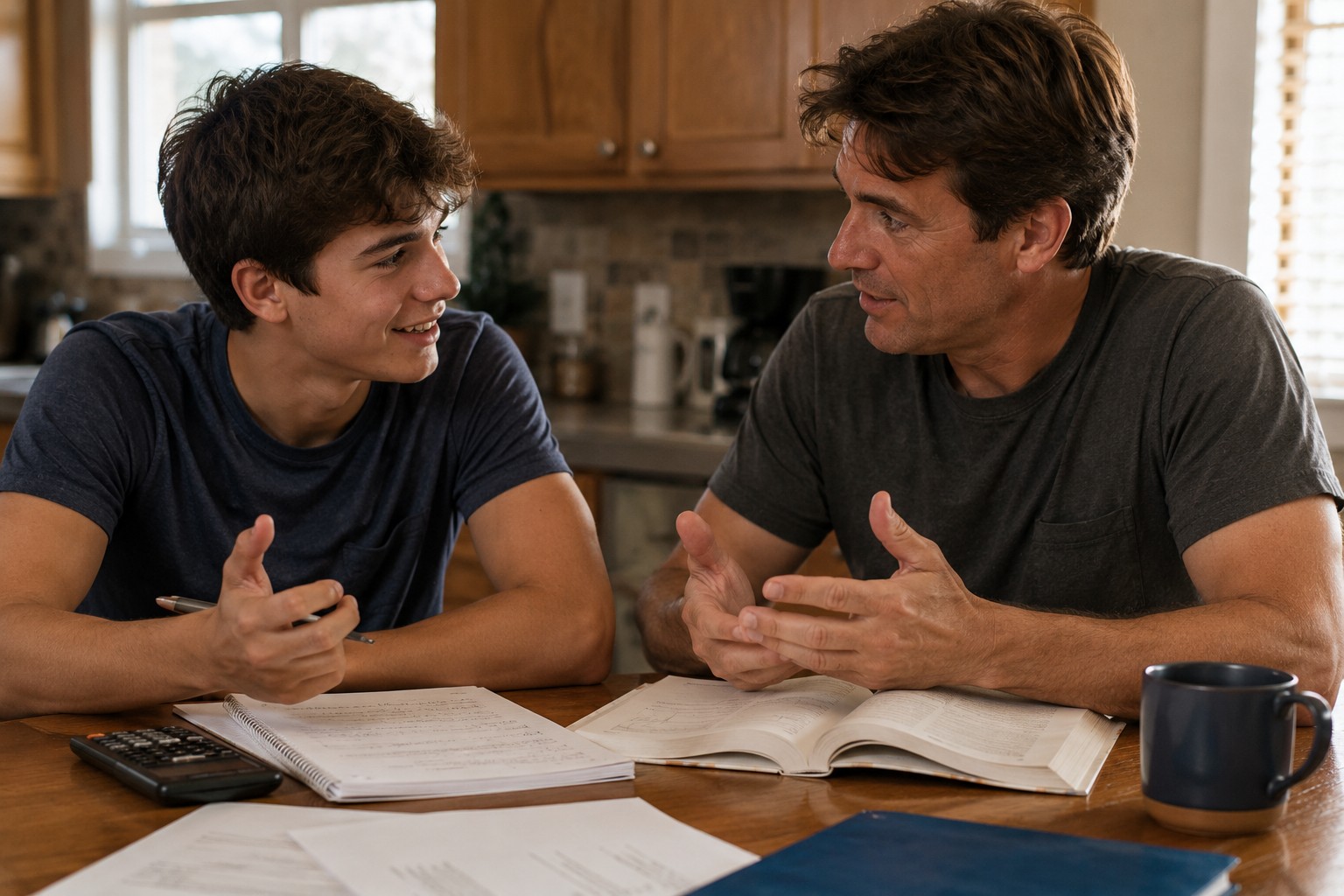
Math Anxiety Is Real
When a child becomes frustrated, freezes when presented with a problem, avoids math, or repeatedly announces that they are "bad at math," parents should not automatically interpret it as laziness.
There can be genuine anxiety behind those words.
The OECD's PISA 2022 research provides a striking picture. Across OECD countries, 65% of 15-year-old students reported worrying about receiving poor marks in mathematics, 55% worried about failing math, and around 40% reported feeling nervous, helpless, or anxious while solving math problems or doing math homework.
That's a lot of children experiencing math as an emotional challenge as well as an academic one.
Even more importantly, PISA found that mathematics anxiety has increased since 2012 in most participating countries and economies. Higher mathematics anxiety was also associated with lower mathematics performance.
So when your child says, "I can't do math," don't hear only the words.
Ask yourself:
What is happening underneath them?
Sometimes the Problem Isn't the Problem
My calculus book wasn't the only thing sitting at that table with me that night.
There was frustration.
There was anger.
There were years of having a father whose military responsibilities meant that he couldn't always be there.
There was probably some pride as well. I had always considered myself good at math. Suddenly, I needed help.
That can be difficult for a young person.
My mother eventually confronted me about how I had treated my father. She reminded me that I didn't understand everything he had been required to do in the military to provide the roof over our heads and food on our table.
She was right.
I felt terrible.
So I went upstairs and apologized to my father. I explained what I was feeling and why I had reacted the way I did.
And then something important happened.
I let him help me again.
That lesson has stayed with me.
Sometimes a child doesn't need someone standing over them saying, "You should know this already."
They need someone sitting beside them saying:
"Let's figure this out."
Separate Ability From Identity
There is a tremendous difference between saying:
"You don't understand fractions yet."
and:
"You're bad at math."
One describes a temporary academic situation.
The other describes the child.
Parents and educators should be very careful about allowing temporary struggles to become permanent identities.
Even statements that sound positive can sometimes put unnecessary pressure on children. If we constantly tell a child, "You're the smart one," what happens when that child encounters something difficult?
That was part of what happened to me.
Math had been something I was good at.
Then came calculus.
If my identity was tied to being "good at math," what did struggling with calculus say about me?
Nothing, actually.
It simply meant I had reached mathematics that required more effort, different strategies, and some help.
That's what we want children to understand.
Change the Words You Use
Parents can begin changing this mindset immediately.
Instead of focusing primarily on natural ability, draw attention to what the student actually did.
Instead of:
"You're so smart!"
Try:
"I noticed you didn't give up when that got difficult."
"You tried another strategy when the first one didn't work."
"You couldn't solve that yesterday. Look what you can do today."
"Show me how you figured that out."
"That mistake helped us discover what you didn't understand."
"You've improved."
This doesn't mean praising children for everything they do. Children recognize empty praise.
Be specific.
The goal is to help children connect improvement with actions they can control: practicing, thinking, asking questions, trying another method, checking their work, and persisting.
Give Them Victories They Have to Earn
Confidence doesn't come from repeatedly telling a child that they are amazing.
One of the strongest ways to develop confidence is accomplishment.
Give students opportunities to succeed at something that initially feels slightly difficult.
Not impossibly difficult.
Not embarrassingly easy.
Just beyond their current comfort zone.
Imagine a student who can consistently complete Level 3 problems. Instead of immediately jumping to Level 7, give them Level 4.
Let them wrestle with it.
Offer a hint if necessary.
Give them another attempt.
And when they finally solve it, don't immediately say, "See? That was easy!"
It wasn't easy.
That's the entire point.
Say: "You couldn't do that ten minutes ago."
That is evidence.
The student has just demonstrated to themselves that ability can change.
PISA 2022 data provide an interesting connection here. Students with lower math anxiety performed better when they reported a growth mindset than when they reported a fixed mindset. The same pattern appeared among highly math-anxious students: those reporting a growth mindset averaged higher mathematics scores than similarly anxious students with a fixed mindset. These results are associations rather than proof that mindset alone causes higher scores, but they reinforce the importance of how students view their ability to improve.
Five Things You Can Do Today
You don't need to change your entire homeschool curriculum. Start small.
1. Ban the phrase "I'm bad at [fill in the blank] (…math)."
Don't punish children for saying it. Help them rephrase it.
"I'm struggling with this kind of math."
"I don't understand this yet."
"I need more practice with this."
Those statements leave room for tomorrow to be different.
2. Create one achievable challenge.
Give your child something slightly beyond what they can comfortably accomplish.
Then help just enough.
Allow them to experience the satisfaction of breaking through.
3. Stop making speed the definition of mathematical ability.
Some children solve quickly. Others need time to process. Unless speed itself is the skill being practiced, focus on reasoning and accuracy before speed.
Ask:
"How did you get that answer?"
4. Celebrate corrections.
When students discover their own mistakes, acknowledge it.
"You caught it!"
That changes an incorrect answer from evidence of failure into evidence that the student can evaluate and improve their own thinking.
5. Sit beside them occasionally.
Don't always teach from across the table.
Sit beside your child and solve something together.
Say:
"Show me where you're getting stuck."
You might discover that what looks like a mathematics problem is actually a confidence problem, a misunderstanding from three chapters ago, fear of being wrong—or simply a child who needs to know that Mom or Dad is on their team.
Relationships Matter More Than We Realize
The lesson I remember from that night with my father isn't the calculus equation.
I don't remember what problem I was solving.
I remember my father walking upstairs.
I remember my mother's words.
I remember apologizing.
And I remember allowing my dad back into the struggle.
Research offers a meaningful parallel. PISA 2022 found that better student-teacher relationships were associated with lower mathematics anxiety across nearly all participating education systems. OECD findings also show that students reporting stronger family support tended to report greater confidence in self-directed learning and, in most participating systems, less mathematics anxiety.
For homeschool families, that's especially important.
You aren't simply teaching mathematics.
You're building a relationship around learning.
Someday your child may not remember the worksheet you assigned on Tuesday afternoon.
But they may remember that when they were frustrated and convinced they couldn't do something, Mom or Dad sat down beside them and said:
"Okay. Let's figure it out together."
Where Totally Medieval Can Help
This is one reason I believe games can have an important place in mathematics education.
With Totally Medieval, math isn't meant to feel like a judgment about whether a child is "smart" or "bad at math." Mathematics becomes part of an adventure.
Players move across the board, navigate terrain, develop strategies, confront opponents, and use mathematics as part of accomplishing their objectives. Different students can participate at different mathematical levels, allowing a child working on simpler skills to play alongside someone working on more advanced mathematics.
But there's another benefit that I think is equally important.
Parents can play too.
That changes the dynamic.
Instead of always being the person standing over your child's shoulder correcting answers, you can become the person sitting across the table playing with them.
You can laugh together.
Compete.
Make mistakes.
Lose.
Win.
Try again.
And when your child successfully completes a math challenge that they weren't sure they could handle, you are sitting right there to see it happen.
That's where mathematics can become about more than answers.
A child begins learning:
"I can do difficult things."
A parent demonstrates:
"I'm here when you need help."
And both begin developing trust.
My father couldn't make calculus easy for me. What he could do was sit beside me and help me work through something that had become difficult.
Years later, that's the part that matters.
Games like Totally Medieval can give families another opportunity to create those moments—to practice mathematics, certainly, but also to talk, compete, encourage one another, solve problems together, and build relationships around learning.
Because sometimes the most important mathematical breakthrough isn't finally finding the correct answer.
It's the moment a child stops saying:
"I'm just not good at math."
And starts believing:
"I don't know how to do this yet—but I think I can figure it out."