The Forgetting Curve: Why Students Forget—and What Parents Can Do About It
By Xogos Gaming · September 21, 2026
Why Students Forget What They Just Learned
Nearly every homeschool parent and educator has experienced it. Maybe you have as well. Your student studies a subject, seems to understand it, answers the questions correctly, and then a week later you ask about the same topic and receive a blank stare. It can feel as though all that work simply disappeared.
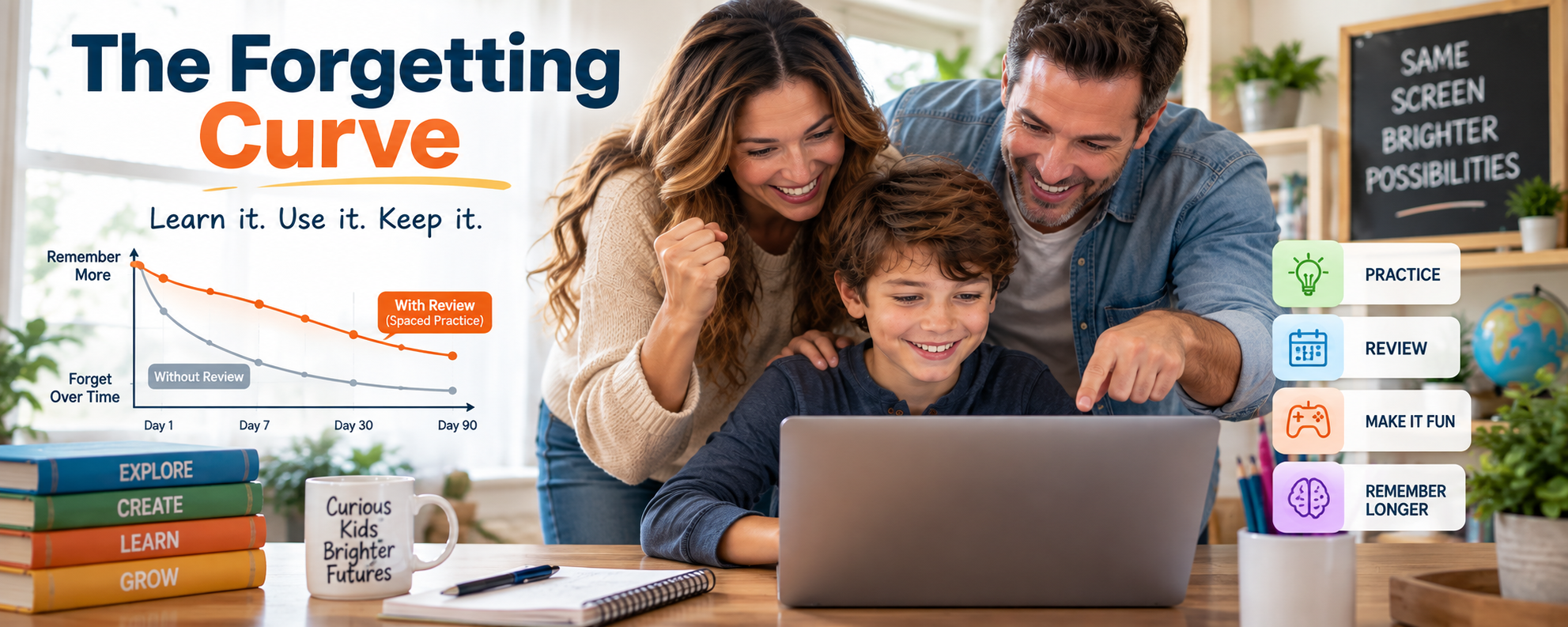
Forgetting, however, is a normal part of human memory. More than a century ago, psychologist Hermann Ebbinghaus demonstrated what became known as the forgetting curve: newly learned information can become increasingly difficult to retrieve as time passes when it is not revisited. Modern memory research has expanded considerably since Ebbinghaus, but the practical lesson remains valuable. If we want students to remember something for months or years instead of merely until Friday's test, they need opportunities to retrieve, apply, and revisit that information.
That means the answer isn't necessarily more studying. It is often better studying.
I Was the Student Who Studied and Still Forgot
I understand this personally. When I was in high school, I tried to do well, but much of school was simply boring to me. I would read chapters, listen to lectures, study for tests, and then struggle to remember information because I couldn't see how most of it applied to my life. I also dealt with test anxiety. I could study something and believe I understood it, only to sit down for an exam and suddenly struggle to retrieve what I knew.
I wasn't a student who didn't care. I simply hadn't discovered a compelling reason for much of the information to matter to me.
Everything changed in college when an English professor gave us an assignment to write a one-page essay about a product we could create in a dorm-room environment that might change our lives. I came up with the idea for a history-based card game. That one-page assignment eventually became Historical Conquest, a fully functioning educational card game that has been sold around the world.
Something else happened along the way: I went from being an A/B/C student to earning straight As. Suddenly, everything I was learning had somewhere to go. History gave me people and events for the cards. Math helped with game mechanics. English helped with writing. Marketing taught me how to reach customers, and business classes helped me understand how to turn an idea into a company. Instead of asking, "Will this be on the test?" I began asking, "How can I use this?" Learning had become applicable to my life, and that gave me a reason to pay attention, remember, and repeatedly use what I was learning.
The Science of Remembering
One of the strongest lessons from modern learning research is that simply rereading material isn't always the best way to create durable memories. Researchers Henry Roediger and Jeffrey Karpicke found that retrieval practice—attempting to recall information from memory—can improve long-term retention compared with additional studying alone.
That doesn't mean giving children more stressful tests. Retrieval can happen through conversations, trivia, games, flashcards, challenges, storytelling, or simply closing the book and asking, "Tell me what you remember."
Another important strategy is spaced practice. Instead of spending three hours studying something once, students benefit from returning to material across multiple learning sessions. A major review by John Dunlosky and colleagues rated practice testing and distributed practice among the most effective learning techniques examined.
Parents can combine these principles quite naturally. Learn something today, retrieve it tomorrow, revisit it several days later, and bring it back again a few weeks afterward. The objective is to prevent learning from becoming a cycle of learn → test → forget.
Mix It Up Instead of Starting Over
Another useful learning strategy is interleaving, which involves mixing different types of material or problems rather than always practicing one type repeatedly before moving to another. Instead of completing 25 nearly identical math problems, for example, a student might encounter multiplication, fractions, percentages, and a few previously learned concepts mixed together. This forces the student to determine which knowledge or strategy applies rather than simply repeating the same procedure.
Parents can use the same principle across subjects. While studying the Civil War, bring back a question from the American Revolution. During geology, ask students to recall something they previously learned in chemistry. While working on percentages, connect the mathematics to a personal-finance problem.
The goal is to help students build connections between knowledge instead of storing every lesson in a separate mental box.
Make Review Something Students Actually Enjoy
Review does not have to mean rereading the same textbook page for the fourth time. In fact, one of the best ways parents can reinforce learning is to make retrieval feel completely different from the original lesson.
Try turning review into activities such as:
- Family Trivia Night: Mix current material with questions from several weeks ago.
- Beat the Parent: Let students compete against Mom or Dad—and write some of the questions themselves.
- Teach Me: Ask the student to explain yesterday's lesson to you without using notes.
- 60-Second Challenge: Give students one minute to write everything they remember about a topic.
- Mystery Mission: Create a puzzle that requires previously learned information to solve.
- Real-World Challenge: Turn percentages into shopping discounts, fractions into cooking, or geography into planning a trip.
These activities aren't merely tricks for making school entertaining. They require students to retrieve information and use it, which is exactly what we ultimately want them to be capable of doing.
Don't Forget Sleep
There is another learning tool that doesn't require a curriculum, computer, worksheet, or game: sleep. Sleep plays an important role in memory consolidation, the processes through which memories become stabilized and integrated. Research reviews continue to find meaningful relationships between sleep and memory across age groups, although effects vary depending on the kind of memory and task being studied.
That is worth remembering when students are tempted to stay up late cramming. A productive learning routine needs both effective practice and adequate rest. Sometimes the appropriate conclusion to a good day of learning really is, "You're done. Go get some sleep."
From Remembering for the Test to Remembering for Life
My own education changed when I stopped learning primarily for the next exam. Historical Conquest gave the information somewhere to go. I was repeatedly retrieving what I had learned, applying it, combining subjects, solving problems, and turning knowledge into something tangible. A one-page college essay ultimately became a game sold around the world, but the project also changed the way I learned.
That is an important lesson for homeschool parents and educators. Whenever possible, give knowledge a purpose. Let students build something, debate something, teach something, investigate something, compete, experiment, solve a mystery, or create a project. Then return to that knowledge later and ask them to use it again.
We shouldn't simply ask, "Did my student learn this?" A much better question is, "Can my student still use this?"
How Xogos Reinforces This Kind of Learning
This philosophy is part of what we are building with Xogos. Games naturally create opportunities for concepts to return through challenges, competition, decisions, exploration, and repeated application. Instead of encountering information once and abandoning it after the test, students can repeatedly use knowledge while trying to accomplish something they care about.
Xogos is designed to reinforce K–12 learning through educational games and digital experiences while complementing what parents and educators are already teaching. The goal isn't to replace books, teachers, homeschool parents, projects, experiments, or real-world experiences. It is to provide another way for students to practice and apply what they're learning.
My educational life changed when information stopped being something I had to remember long enough to pass a test and became something I could use.
That's the opportunity we should give students: learn it, retrieve it, apply it, revisit it, and eventually own it.
Because the real measure of education isn't whether a student remembers the answer tomorrow.
It's whether that knowledge is still there when they need it years from now.